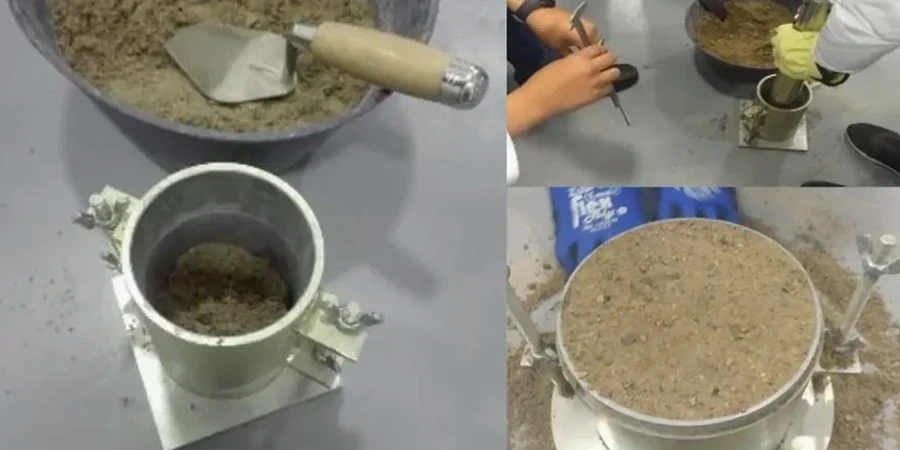
Le moule Proctor standardisé claque sur le sol du laboratoire quand le marteau normalisé de 2,5 kg achève ses 25 coups par couche. C'est le rythme qu'on entend régulièrement dans notre labo quand arrivent des échantillons de limons argileux prélevés sur les terrasses alluviales de la Têt, autour de Perpignan. L'essai Proctor, qu'il soit Normal ou Modifié, reste la boussole pour tout terrassement sérieux en Roussillon. On détermine la teneur en eau optimale et la densité sèche maximale qu'un sol peut atteindre avec l'énergie de compactage prévue. En pratique, c'est ce qui évite les affaissements de chaussée sur le secteur de Saint-Charles ou les déformations de plateforme logistique près du Marché International. La différence entre le Proctor Normal et le Modifié tient dans l'énergie déployée : 600 kN·m/m³ pour le Normal, environ 2700 pour le Modifié. Le choix dépend directement du type de compacteur retenu sur site. Pour les sols sensibles à l'eau de la plaine perpignanaise, on combine souvent cet essai avec une analyse granulométrique complète et la détermination des limites d'Atterberg pour bien cerner le fuseau d'utilisation du matériau.
Un écart de 1 % d'eau dans un limon de la Têt, et vous perdez 5 % de densité sèche. C'est la précision qu'apporte l'essai Proctor.
Démarche et périmètre
Particularités du site
In numerous subdivision projects around Perpignan, a commonly observed problem is the compaction of materials assumed to be water-insensitive, yet they actually have a very flat Proctor curve. This implies that density varies minimally with moisture, which can be misleading. The site supervisor thinks the soil is well-compacted, but it's only stable due to its dry state. Upon the first autumn rains, the silt becomes saturated, capillary suction ceases, and the fill settles by 10 to 15 cm. This phenomenon has been noted in housing estate expansions towards Toulouges. Another local trap involves fills made from rounded Têt river gravels. These draining materials are ideal for subgrade layers but require a Modified Proctor test to meet the 98% OPM demanded for roadworks. Relying on a Normal Proctor underestimates compaction energy and risks excessive deflections under bus traffic. The NF P 11-300 (GTR) standard guides us in classifying these soils to avoid such issues.
Cadre normatif
The relevant standards include NF P 94-093 (covering both Normal and Modified), NF EN 13286-50, NF P 11-300 (GTR), and NF EN 13286-2.
Autres services liés
Essai Proctor Normal (NF P 94-093)
This test determines the maximum dry density and optimal water content for standard compaction energies. It is suited for landscaping fills, network trenches, and foundations of light slabs.
Essai Proctor Modifié (NF P 94-093)
This standard is the reference for subgrade layers, industrial platforms, and heavy roadways. It is used for compaction controls at 95% or 98% of the Modified Proctor Optimum (OPM).
Étude de valorisation des matériaux de site
Identification and classification according to GTR of soils excavated on-site for reuse as fill. This is essential to reduce disposal and quarry imports.
Contrôle de compactage in situ
Dry density is measured using the sand cone method or a membrane densitometer, then compared to the laboratory Proctor reference to validate the compacted layers.
Paramètres typiques
Consultations fréquentes
Quelle est la différence entre le Proctor Normal et le Proctor Modifié pour mon chantier à Perpignan ?
A Normal Proctor simulates the energy of a light compactor or a 500 kg vibrating plate. A Modified Proctor replicates the energy of a heavy 10-tonne vibrating roller. In the Roussillon plain, the Modified version is mandatory for subbase layers under roads and industrial building platforms. For a simple landscaping fill or a sidewalk utility trench, the Normal Proctor suffices.
Combien coûte un essai Proctor en laboratoire sur Perpignan ?
A full Proctor test with a 5-point compaction curve costs between 100 € and 200 €, depending on whether it is Normal or Modified and the soil type. Gravelly soils require preliminary sieving, which can increase the price. A detailed quote is provided after sample inspection.
Quel délai pour obtenir les résultats d'un Proctor ?
Results are typically delivered within 48 to 72 business hours after receiving the sample. The test itself takes half a day, but oven drying of the test portions to determine actual moisture content requires a full night. If the project is on hold, we can provide the dry density as early as the next morning.
Quelle quantité de sol dois-je prélever pour un essai Proctor ?
About 40 to 50 kg of representative material is needed, collected in an airtight bag to preserve natural moisture. For Têt gravels or Salamque silts, we require a remolded bulk sample, not a core. Avoid surface sampling, as these are often dried out by the tramontane wind.
Est-ce que le Proctor suffit pour garantir la stabilité d'un remblai ?
The Proctor curve provides the compaction reference but says nothing about the final bearing capacity. In Perpignan, we systematically combine the Proctor test with a CBR test for roads, or a plate load test for slabs. The Proctor tells you how to compact; the CBR or plate test tells you if the compacted soil is strong enough for the intended use.